Bangkok Street Food: A Field Guide to Eating Everything From Every Stall
Bangkok has roughly 300,000 street food vendors, which means that at any given moment, someone within a hundred metres of you is grilling pork over charcoal, and it smells better than anything you have ever cooked in your entire life. This is not a city where you "find" good street food. This is a city where good street food finds you, tackles you to the ground, and feeds you a £1.20 plate of pad thai so transcendent it makes you briefly reconsider every life decision that led you to ever eat pad thai anywhere else. If you are staying at a hotel in Bangkok and eating at the hotel restaurant, you are committing a crime. Not a metaphorical crime. An actual crime against food, against Thailand, and against the concept of being alive and having a functioning mouth.
The First Rule of Bangkok Street Food
Follow the smoke. This is not poetic advice. This is literal navigational instruction. The best food in Bangkok is being cooked over open flames by someone who has been making the same dish for thirty years and has no interest in your dietary requirements, your Instagram grid, or your feelings. You will find them by following the plumes of charcoal smoke rising between buildings like delicious smoke signals. If a stall has no smoke, no queue, and a laminated English menu with photographs, you have made a wrong turn and should correct course immediately.
The second rule: eat when the locals eat. Bangkok's street food operates on a schedule that has nothing to do with your jet-lagged stomach. Boat noodles are a lunch thing. Yaowarat is an after-dark thing. Moo ping appears at dawn like a pork-scented sunrise. Showing up at the wrong time isn't just suboptimal - the stall literally won't be there. It will be a shuttered metal grate and a confused dog. Timing is everything. The third rule: if there's a queue, join it. Do not ask what is being served. It doesn't matter. A queue of Thai people at a street stall is the most reliable restaurant review system ever devised. Michelin has three stars. A Bangkok queue has forty people who skipped lunch at work to stand in 35°C heat for a bowl of noodles. Trust the queue.
Yaowarat After Dark: Chinatown Becomes a Food Hallucination
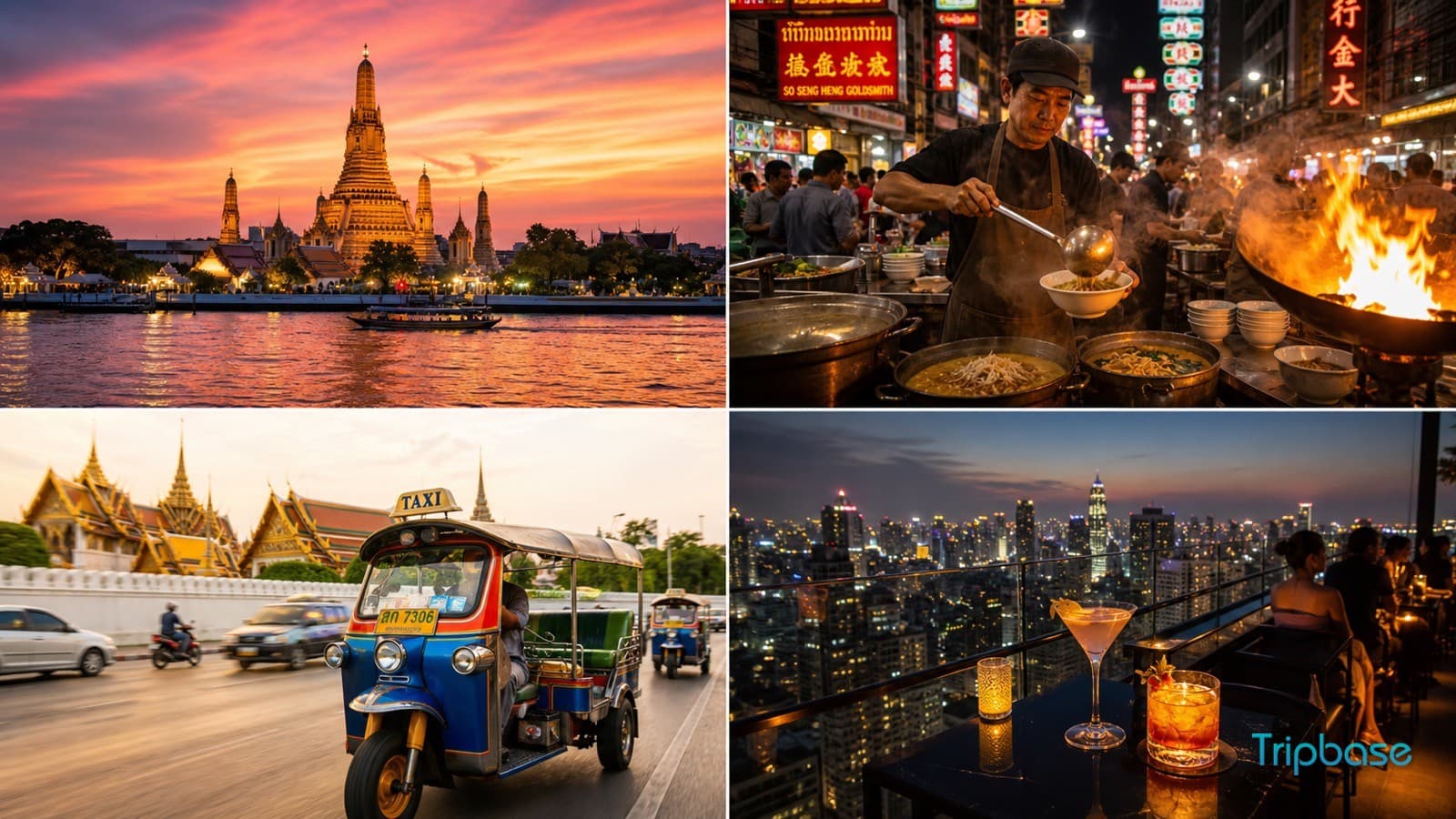
Bangkok's Chinatown - Yaowarat Road - transforms at nightfall from a mildly chaotic street of gold shops and Chinese signage into a fully unhinged, neon-lit, smoke-drenched food carnival that looks like Blade Runner if Ridley Scott had a deep passion for crab omelettes. The street stalls materialise around 6pm as if summoned by some ancient culinary ritual, and by 8pm the entire road is a wall-to-wall procession of woks, grills, steamers, and plastic stools.
Start with the seafood. Yaowarat's grilled river prawns are the size of a grown man's forearm, split and charred over coals until the shell is crackling and the flesh inside is sweet and obscene. They cost about 200 baht each, which is roughly £4.50, which is roughly the cost of a single prawn tail at any restaurant in London that has the word "market" in its name. The crab omelette - a volcanic, eggs-barely-holding-it-together situation loaded with claw meat - is served at several stalls, and honestly they're all good because the baseline for crab omelette in Yaowarat is higher than the ceiling of most Western restaurants.
Then there's the ba mee (egg noodles), the roasted duck, the rolled ice cream, the mango sticky rice vendors who materialise at the exact moment you think you can't eat any more, which is a lie, because you can always eat mango sticky rice. Your stomach is more resilient than you think. Bangkok will prove this.
Victory Monument Boat Noodles: Tiny Bowls, Enormous Consequences
Boat noodles - kuay teow reua - are Bangkok's most deranged culinary proposition. They are served in bowls roughly the size of a teacup, they cost about 15 baht each (approximately 35p), and the correct number to order is "more than you think." Eight to twelve bowls is a standard sitting. Some people stack their empties into towers as a form of competitive dining performance art. The broth is dark, intensely spiced, and thickened with a small amount of blood, which sounds alarming but tastes like what beef broth has been trying to be its entire life.
The boat noodle alley near Victory Monument BTS station is the canonical spot, though the vendors have shifted around over the years because Bangkok's street food geography is about as stable as tectonic plates. Look for the cluster of stalls with tiny metal tables and the unmistakable energy of a place where nobody is taking photos and everyone is eating with purpose. You'll choose your noodle type (sen lek, sen yai, sen mee, or ba mee), your protein (pork or beef, though pork is the traditional move), and then you'll begin the deeply satisfying process of consuming many small bowls in rapid succession while a Thai grandmother watches you with an expression that hovers between approval and clinical assessment.
The Markets: Where Food Goes to Get Serious
Or Tor Kor Market, adjacent to Chatuchak Weekend Market, is what happens when a Thai wet market goes to finishing school. It's been called one of the best fresh markets in the world, and for once the superlative is earned. The produce is absurd - durians the size of footballs, mangosteens so perfect they look 3D-printed, coconuts being hacked open with a machete by a woman who could definitely take you in a fight. The prepared food section at the back serves restaurant-quality pad thai, som tum, and curries at prices that would make a London food court weep into its overpriced grain bowl.
Khlong Toei Market is the opposite experience. This is Bangkok's largest wholesale wet market, and it operates with the gentle calm of a stock exchange floor during a crash. It is loud, wet, fragrant in ways that include but are not limited to "pleasant," and absolutely not the place for anyone who needs their food to come in packaging with a barcode. This is where Bangkok's restaurants buy their ingredients at 5am, and if you go early enough you can eat some of the most honest, no-frills food in the city - grilled meats, fresh noodle soups, and coffee so strong it could restart a stopped heart.
Wang Lang Market, across the river from the Grand Palace, is the stealth pick. Most tourists take the ferry to the Grand Palace side and never come back, which means Wang Lang stays local. The market runs through narrow covered alleys and sells everything from fried chicken to kanom (Thai sweets) to bags of fresh fruit for 20 baht. It's the market where you realise that Bangkok's food scene isn't something you need to seek out - it's the ambient background radiation of the entire city.
The Dishes You Must Not Leave Without Eating
Pad thai, obviously, but specifically the pad thai at Thip Samai on Maha Chai Road, which has been making one dish since 1966 and has gotten rather good at it, in the same way that Beethoven got rather good at symphonies. The "superb" version wraps the noodles in a crispy egg net that shatters when you press your fork into it, revealing the smoky, tamarind-sweet, slightly charred noodles beneath. There is a queue. Join it. (See: Rule Three.)
Som tum - green papaya salad - is the dish that separates tourists from travelers. It is pounded to order in a clay mortar, and you can specify your spice level, though be aware that Thai "medium" is most people's "I need to call someone." The version with salted crab (som tum boo) is traditional and funky in a way that certain adventurous eaters will find revelatory and others will find concerning. Start with the standard som tum thai if you're not yet ready to commit to fermented crustaceans at 11am.
Moo ping - grilled pork skewers - are Bangkok's breakfast of champions. Marinated in garlic, coriander root, fish sauce, and palm sugar, then grilled over charcoal until caramelised and slightly smoky, they appear at street stalls around 6am paired with bags of sticky rice. They cost about 10 baht per stick (23p), which means you can eat like royalty for less than the cost of a London bus ticket. The correct breakfast is four to five sticks, a bag of sticky rice, and an iced coffee so sweet it technically qualifies as dessert. This is not health food. This is happiness food. They are different categories.
Khao man gai - chicken rice - is the dish that looks boring, tastes transcendent, and makes you angry at every piece of chicken you've ever eaten that wasn't poached in this specific way. The chicken is silky, the rice is cooked in chicken fat and garlic, and the sauce - a ginger-chilli-soybean situation - ties the whole thing together with the quiet confidence of a dish that knows it's perfect and doesn't need to show off. Every neighbourhood has a khao man gai stall. They are all within shouting distance of excellent. Find one, sit down, and have a small existential crisis about chicken.
Silom Soi 20 and the Ari Neighbourhood: Eating Off the Tourist Map
Silom Soi 20 is a narrow lane in the business district that becomes a lunchtime food court of extraordinary quality between about 11am and 1:30pm, then ceases to exist. Office workers descend from the towers, queue at their preferred stalls, eat something astonishing for 50 baht, and return to their spreadsheets. You can join them. Nobody will mind. The pad kra pao (basil stir-fry) here is lethal in the best way - heavy on the holy basil, heavy on the chilli, served over rice with a fried egg that has crispy edges and a yolk that functions as a sauce. It is one of the great lunches on Earth and it costs less than a bag of crisps at a London train station.
The Ari neighbourhood, up the BTS Sukhumvit line, is where young Bangkok goes to eat things that are slightly fancier than street food but maintain the same fundamental commitment to flavour over pretension. It's coffee shops that roast their own beans, craft cocktail bars next to som tum carts, and a general vibe of "we care about food but we're not weird about it." Eating like a local in Ari means a late brunch of khao soi (northern-style curry noodles) followed by iced Thai tea and a wander through a neighbourhood that hasn't yet appeared in a listicle with the word "hidden" in the title.
Mango Sticky Rice and the Art of the Street Dessert
We need to discuss mango sticky rice (khao niao mamuang) with the seriousness it deserves, which is more seriousness than most people give it. This is not just "fruit with rice." This is warm, pandan-scented glutinous rice soaked in sweetened coconut cream, served with slices of nam dok mai mango so ripe they're essentially mango butter, then drizzled with more coconut cream and topped with crispy mung beans. It is simple, devastating, and makes every Western dessert you've ever eaten feel like it was trying too hard. The best mango sticky rice in Bangkok appears between March and June, when nam dok mai mangoes are in season and the universe is briefly, tangibly good.
As the food-first traveler knows, the best meals in any city are rarely the ones you planned. They're the ones you stumbled into at 10pm because you followed the smoke, joined the queue, and trusted a city that has been feeding people brilliantly for longer than most countries have existed. Bangkok doesn't need your restaurant reservations. Bangkok needs you to sit on a plastic stool, point at whatever the person next to you is eating, and prepare to have your understanding of food quietly, permanently rearranged.