
How Air Ambulances Work: Aircraft Types, Medical Equipment, and What to Expect
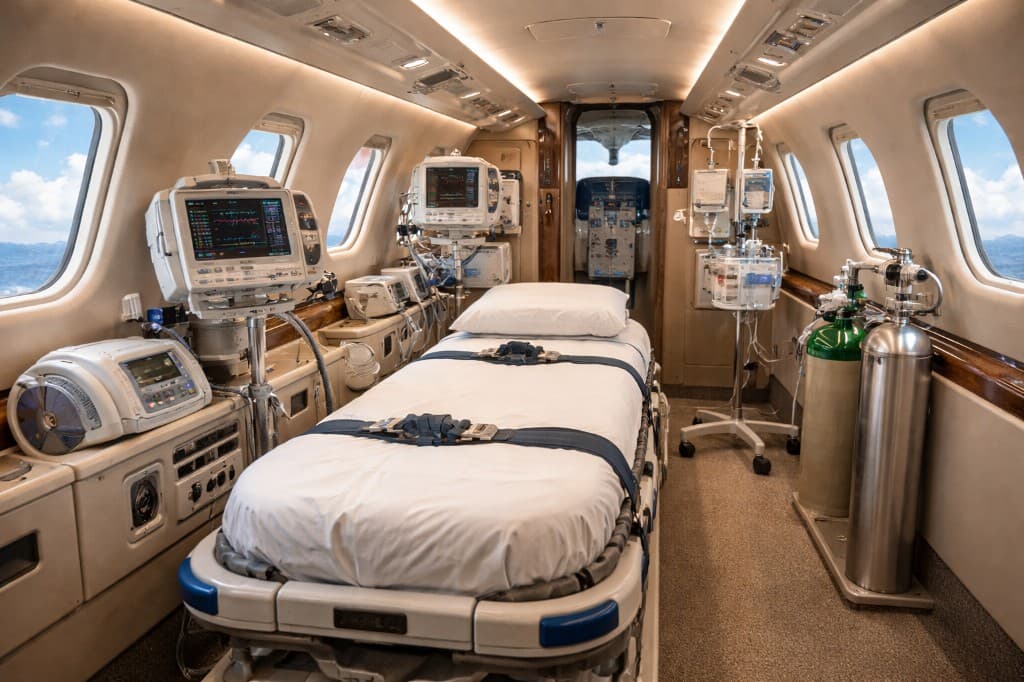
An air ambulance is not just a fast ride to the hospital. It is a flying intensive care unit - a pressurized aircraft packed with the same life-saving equipment you would find in an emergency room, staffed by flight nurses and paramedics who specialize in delivering critical care at 30,000 feet. Here is how it all works.
Two Types of Air Ambulance: Helicopter vs Fixed-Wing
The term "air ambulance" covers two fundamentally different aircraft categories, each designed for different missions.
Helicopter Air Ambulances (Rotor-Wing)
Helicopters are the first aircraft most people picture when they hear "air ambulance." These are the machines that land on motorway medians, mountain ledges, and hospital rooftop helipads. Their defining advantage is the ability to operate without a runway - they can reach accident scenes, remote hiking trails, and offshore vessels that no airplane could access.
Common aircraft:
- Airbus H145 (EC145): The workhorse of European HEMS (Helicopter Emergency Medical Services). Twin-engine, large cabin, rear clamshell doors for easy stretcher loading. Cruise speed: 150 mph. Range: 370 miles.
- Bell 407: Widely used in the US for emergency medical services. Single-engine, fast, reliable. Cruise speed: 140 mph. Range: 350 miles.
- Leonardo AW139: Larger twin-engine helicopter used for offshore operations and inter-hospital transfers. Cruise speed: 165 mph. Range: 575 miles.
- Airbus H135 (EC135): Compact twin-engine helicopter popular with urban HEMS programs. Cruise speed: 155 mph. Range: 395 miles.
Helicopter air ambulances typically operate within a 150-mile radius. They are ideal for the "golden hour" - the critical first 60 minutes after a trauma where rapid hospital access dramatically improves survival. A helicopter can cut a 90-minute ground ambulance journey to 20 minutes.
Fixed-Wing Air Ambulances (Airplane)
For distances beyond 150 miles - and especially for international medical transport - fixed-wing aircraft take over. These are typically business jets or turboprops that have been modified to carry a medical stretcher, monitoring equipment, and a full medical crew alongside the flight crew.
Common aircraft:
- Learjet 35A / 45: The most common dedicated air ambulance jet. Fast (500+ mph), pressurized, and large enough for a stretcher, two medical crew, and a family member. Range: 1,800-2,000 miles.
- Beechcraft King Air 350: A twin turboprop used for medium-range transfers. Slower than a jet (310 mph) but more versatile - it can operate from shorter runways, including some rural airstrips. Range: 1,800 miles.
- Hawker 800XP: A mid-size jet with a larger cabin, used for long-range international repatriations. Range: 2,900 miles. Cruise speed: 450 mph.
- Challenger 604/605: A large-cabin jet used for ultra-long-range medical flights - transatlantic and beyond. Can accommodate multiple patients or a family escort. Range: 4,000 miles.
Fixed-wing air ambulances require a runway at both ends, which means ground ambulance transfers between the hospital and the airport are always part of the mission. For international flights, the logistics include overflight permits, customs clearance, fuel stops, and crew rest requirements.
Inside the Aircraft: Medical Equipment
A dedicated air ambulance - whether helicopter or fixed-wing - carries equipment comparable to a hospital intensive care unit. The specific loadout depends on the patient's needs, but a standard configuration includes:
- Multi-parameter patient monitor: Tracks heart rhythm (ECG), blood pressure, blood oxygen saturation (SpO2), capnography (end-tidal CO2), and temperature. These are aviation-grade devices designed to function reliably despite vibration, altitude changes, and electromagnetic interference from the aircraft.
- Mechanical ventilator: For patients who cannot breathe independently. Flight ventilators are portable, battery-powered, and rated for use in pressurized and unpressurized cabins.
- Infusion pumps: Precise IV medication delivery - critical for patients on vasopressors, sedatives, or pain medication.
- Defibrillator/pacer: For cardiac emergencies. Combination devices that can defibrillate, cardiovert, and externally pace the heart.
- Portable suction device: Clears airways of blood, mucus, or vomit.
- Oxygen supply: Medical-grade oxygen cylinders or a liquid oxygen system. Enough for the entire flight duration plus reserves.
- Portable ultrasound: Increasingly standard on air ambulances for in-flight assessment of internal bleeding, cardiac function, and pneumothorax.
- Full medication kit: A pharmacy of emergency drugs including epinephrine, atropine, amiodarone, fentanyl, midazolam, antibiotics, blood thinners, and anti-nausea medications. International flights carry a broader range to cover in-flight complications.
- Blood products: Some advanced air ambulance services carry packed red blood cells and plasma for trauma patients, though this is not universal.
The medical stretcher itself is purpose-built for aviation: lightweight aluminium or carbon fibre, with a hydraulic or electric loading system that transfers the patient smoothly between the ground ambulance and the aircraft cabin.
The Medical Crew
The people on board are as important as the equipment. Air ambulance medical crews are specialized - they are not regular hospital staff who happen to be on an aircraft. They are trained specifically for the challenges of delivering care in a moving, confined, noisy, altitude-changing environment.
Standard crew for a non-critical patient:
- Flight nurse (often a Certified Flight Registered Nurse, CFRN) - the lead clinician on most missions. CFRNs have ICU or emergency department backgrounds plus specialized flight physiology training.
- Flight paramedic (often a Flight Paramedic-Certified, FP-C) - works alongside the nurse. Strong in airway management, trauma care, and cardiac emergencies.
Upgraded crew for critical patients:
- Physician - typically an emergency medicine, critical care, or anaesthesiology specialist. Required for patients on ventilators, vasopressors, or with unstable conditions that may deteriorate in flight.
- Respiratory therapist - for ventilator-dependent patients, especially on long international flights.
- Neonatal specialist - for transporting critically ill newborns in an isolette (a portable incubator with built-in ventilation and monitoring).
The flight crew - pilot and co-pilot - are separate from the medical team. They have no medical role; their job is to fly the aircraft safely. On international flights, two pilots are required to manage long duty hours and fuel stop operations.
A Typical Mission: From Call to Handoff
Here is what a typical dedicated air ambulance mission looks like:
Hour 0: The assistance company or requesting hospital contacts the air ambulance operator. The operations team assesses the case: patient condition, origin and destination, aircraft availability, and weather.
Hour 1-4: The medical crew reviews the patient's records and prepares equipment specific to the case. The aircraft is prepped, fuel loaded, and a flight plan filed. For international flights, the permits team begins securing overflight and landing clearances.
Hour 4-8: The aircraft departs for the patient's location (this is the "positioning leg" - the empty flight to reach the patient). For domestic missions, this may be under an hour. For international missions, it could be 6-15 hours.
On arrival: A ground ambulance brings the patient from the hospital to the airport. The air ambulance medical crew performs their own assessment, ensures the patient is stable enough for flight, and loads the patient into the aircraft. A face-to-face briefing with the local medical team covers diagnosis, treatment so far, current medications, and any in-flight risks.
In flight: Continuous monitoring. The medical crew documents vital signs every 15 minutes (more frequently for critical patients), manages medications, and communicates with the operations center on the ground. If the patient's condition changes, the crew has protocols for diversion to an alternate airport and hospital.
On arrival at destination: A ground ambulance meets the aircraft at the destination airport. The medical crew performs a handoff briefing with the ambulance team, including all records and a verbal summary. The patient is transported to the receiving hospital, where the admitting team has been pre-briefed by the assistance company.
Commercial Medical Escort: The Budget Alternative
Not every patient who needs to travel by air requires a dedicated air ambulance. For stable patients - someone with a broken leg that has been surgically repaired, a recovering stroke patient, or a traveler with a manageable illness - a commercial medical escort is often the better option.
A commercial medical escort involves a flight nurse or physician accompanying the patient on a regular scheduled airline flight. Depending on the patient's mobility, they may sit in a standard business class seat, or the airline may install a stretcher across a row of economy seats (this requires removing 6-9 seats and costs $10,000 - $20,000 from the airline alone, plus the escort's fees).
The total cost is typically $10,000 - $35,000, compared to $100,000 - $300,000 for a dedicated air ambulance. The trade-offs are less equipment, less flexibility (you are on the airline's schedule), and the patient must be stable enough for a commercial cabin. But for the right patient, it is a sensible and dramatically cheaper choice.
What Passengers and Families Should Know
If you or a loved one ever needs an air ambulance, a few things are worth knowing in advance:
- Family members can usually travel on the aircraft. Most fixed-wing air ambulances have space for one companion. Some larger aircraft (Challenger class) can accommodate two. Helicopter air ambulances rarely have room for passengers due to weight constraints.
- The patient's comfort is a priority. Air ambulance crews manage pain aggressively, control cabin temperature and noise, and keep the patient informed throughout the flight. It is a medical environment, but it is not cold or clinical.
- The process takes longer than you expect. International evacuations typically take 24-72 hours from authorization to arrival at the destination hospital. Permits, crew positioning, and weather can extend this. Patience during this phase is difficult but necessary.
- Cost is negotiable. If you are paying out of pocket, air ambulance operators often offer payment plans or reduced rates through brokers who can compare quotes from multiple providers.
Air ambulances exist at the intersection of aviation and medicine - two of the most highly regulated, safety-conscious industries on earth. The people who crew these aircraft are among the most skilled medical professionals in the world, operating in one of the most challenging environments imaginable. Understanding how the system works takes some of the fear out of a situation that no traveler wants to face.
Have you ever been on or witnessed an air ambulance in action? What surprised you most about the experience? We would love to hear your story.