Lakes That Can Kill You
Water is, we are repeatedly told, the source of all life. This is true, and also incomplete, because a handful of lakes have quietly gone into the opposite business.
Most bodies of water will kill you only if you do something stupid in them, which is a fair arrangement. The lakes below are different. They will kill you while you stand politely on the shore, minding your own business, admiring the view. Some are venting gas, some are the temperature of a kettle, one is radioactive enough to end you in an afternoon, and one has been calmly waiting for decades to smother a couple of million people at once. All of them are real, all of them are still there, and all of the following is, unfortunately, accurate.
Lake Nyos, Cameroon
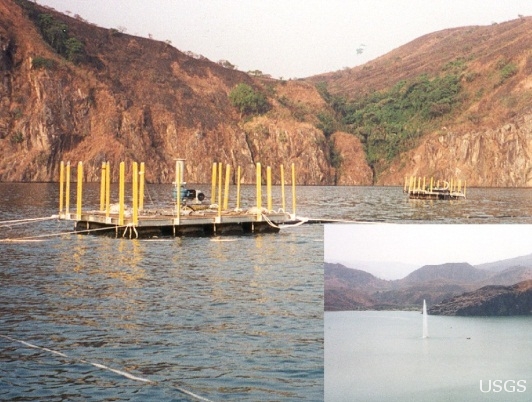
On the night of 21 August 1986, Lake Nyos in northwestern Cameroon exhaled. A vast cloud of carbon dioxide, which had been building up in the lake's deep water from the magma below, was released in a single catastrophic burst known as a limnic eruption. Being heavier than air, the invisible cloud rolled down the surrounding valleys and displaced the oxygen for miles. It killed roughly 1,700 people and around 3,500 livestock, most of them in their sleep, without a sound.
The horror of Nyos is its total lack of drama. There was no explosion you could point at, no wave, no fire, just a lake that looked ordinary and a morning where the villages simply didn't wake up. Engineers have since installed degassing pipes that fountain the deep water upward to bleed the pressure off gradually, which is a very calm solution to a lake that murdered a valley. It works, mostly. The word "mostly" is doing a great deal of quiet labour in that sentence.
Lake Natron, Tanzania
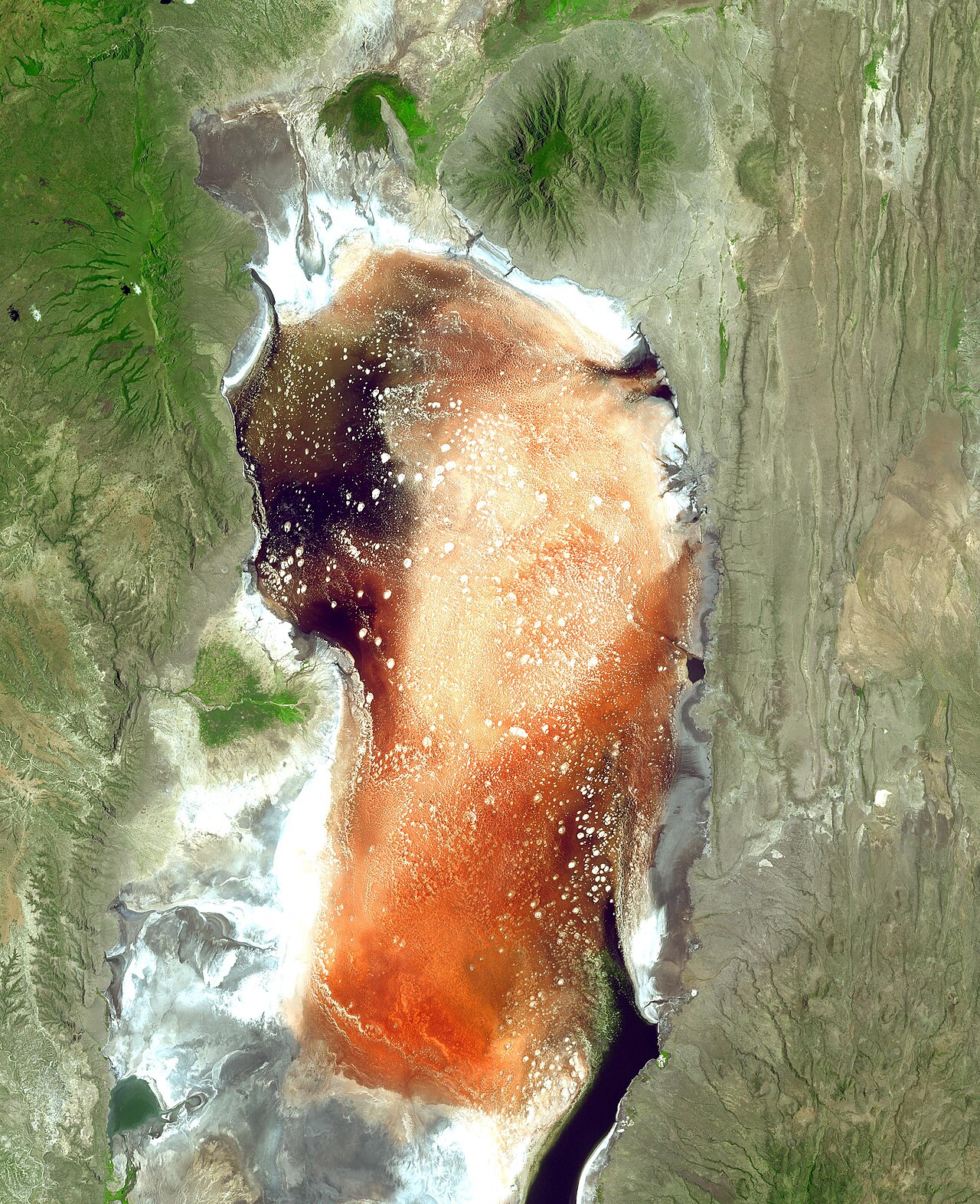
In the north of Tanzania, fed by the ash of the nearby volcano Ol Doinyo Lengai, Lake Natron is a shallow, blood-red sheet of extremely alkaline water. Its pH can climb toward 10.5, roughly that of household ammonia, and its temperatures can reach 60°C. This is not a swimming lake. This is a lake that would like a word with your skin.
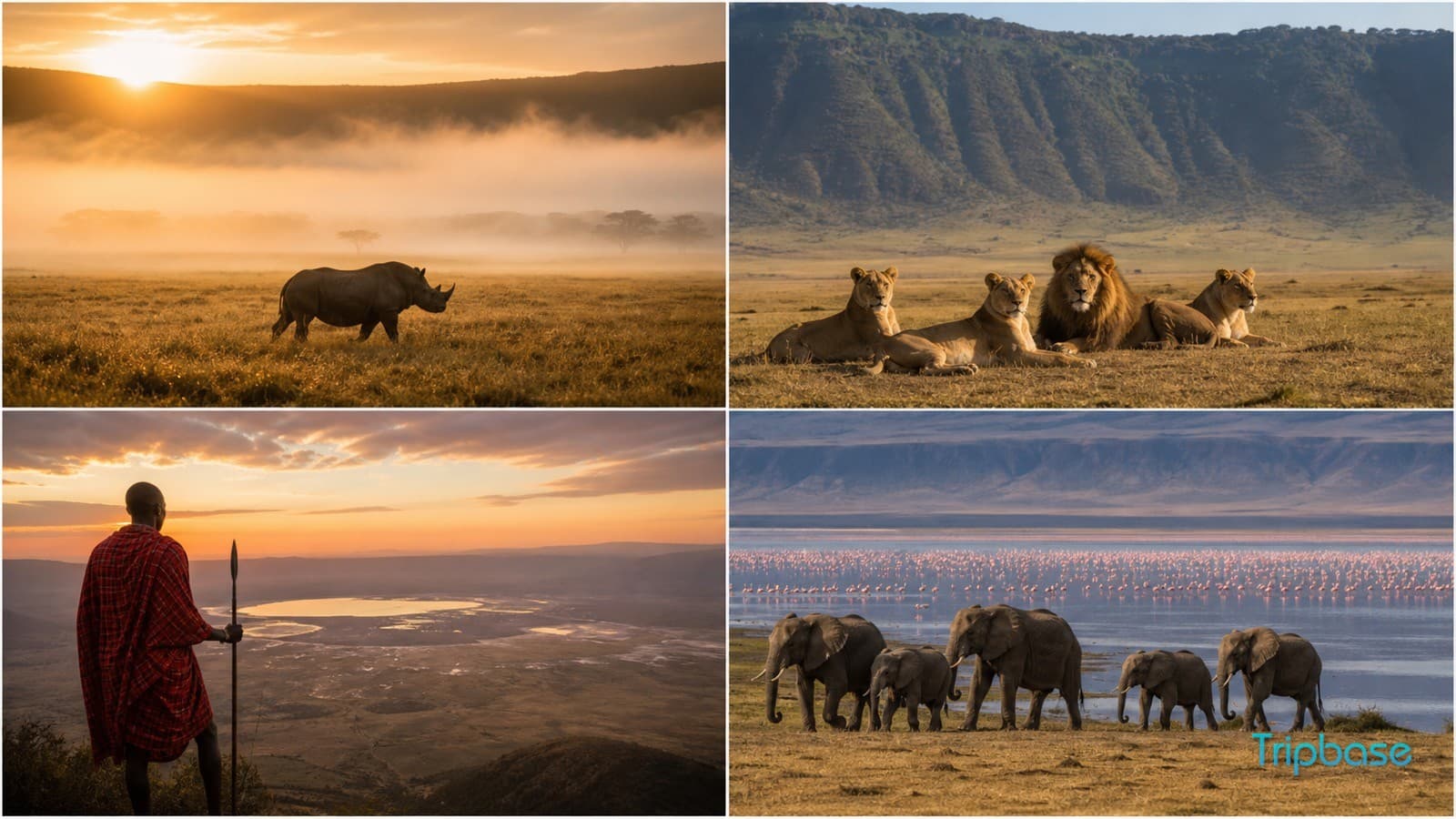
Natron earned its reputation through eerie photographs of calcified birds and bats, preserved mid-pose by the caustic waters like macabre statues. Contrary to the internet's favourite version, the lake does not turn living animals to stone on contact, which would be a step too far even for this list. What it does is preserve the dead with its sodium-rich chemistry, so anything that dies in it emerges looking like a museum exhibit. Bafflingly, it is also one of the most important breeding grounds on Earth for lesser flamingos, who find the hostile conditions ideal precisely because almost nothing else can survive to bother them. It's within reach of the northern safari circuit covered in our Ngorongoro guide, though you'll admire it from a respectful distance.
The Boiling Lake, Dominica
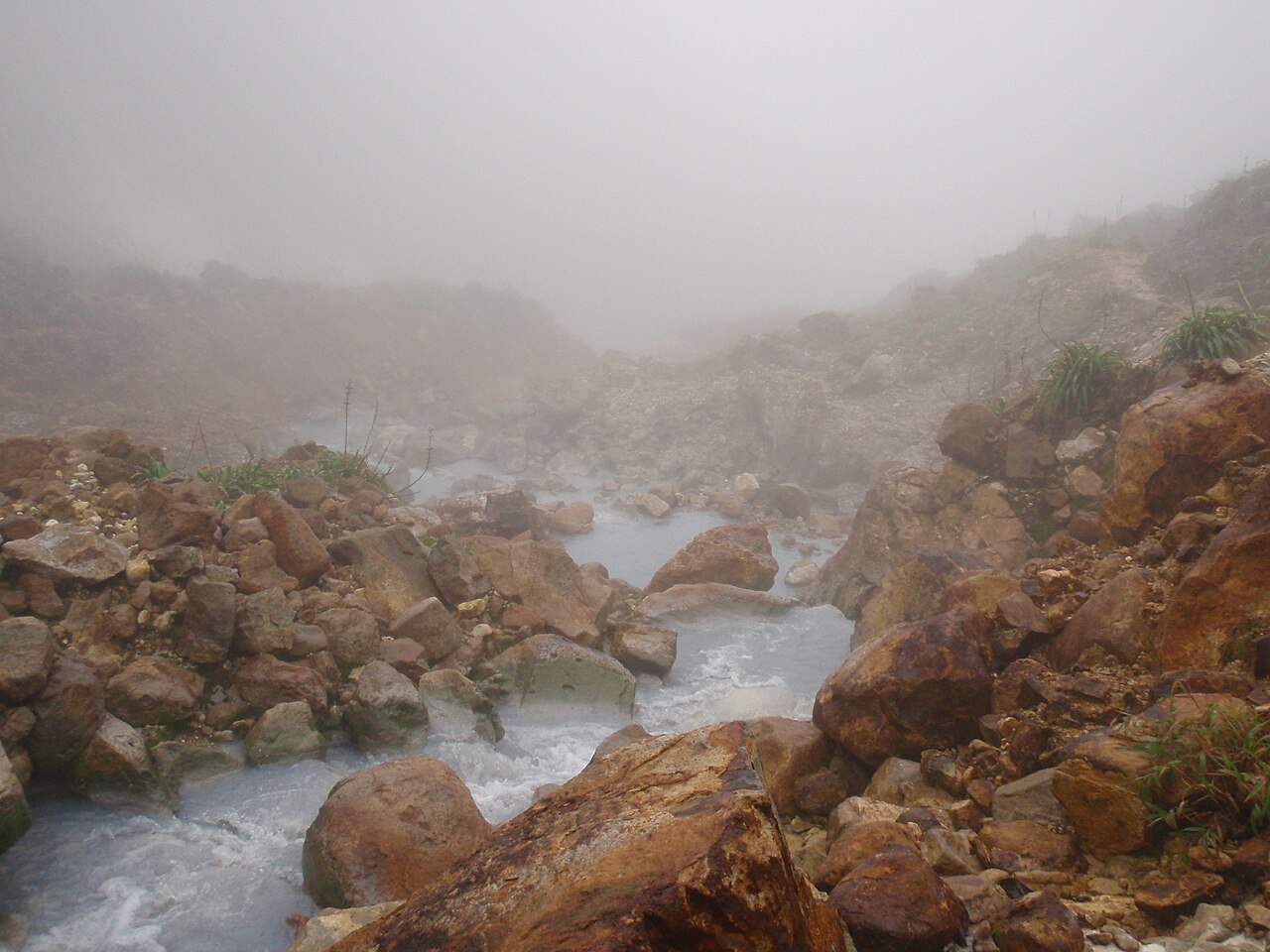
On the Caribbean island of Dominica, tucked inside the Morne Trois Pitons National Park, sits a lake that is exactly what it says on the tin. The Boiling Lake is a flooded fumarole, a crack in the earth's crust venting gas and heat, and its greyish-blue water sits at a rolling boil in the centre with edges hovering somewhere between 82 and 92°C. It is generally reckoned to be the second-largest hot lake in the world, which is a ranking with a small and unlucky field.
Reaching it requires a demanding hike of several hours through the Valley of Desolation, a landscape so cheerfully named it should tell you everything. The reward is a cauldron of steam and churning water that periodically rises and falls in level for reasons the lake declines to explain. It is beautiful, in the way that a thing which would poach you instantly can still be beautiful. Photograph it from the ridge. Do not, under any circumstances, attempt to test the water with a toe.
Lake Karachay, Russia
Some lakes are dangerous by nature. Lake Karachay, in the Ural Mountains, was made dangerous by us, and we really committed to it. For decades the nearby Mayak nuclear facility used this small lake as an open-air dump for radioactive waste, turning it into what has been described as one of the most polluted spots on the planet. At its worst, reports suggested that standing on the shoreline for around an hour would deliver a lethal dose of radiation. Not swimming in it. Not drinking it. Standing next to it.
The lake became so hazardous that a drought in 1967 dried part of it out, and the wind blew radioactive dust across the surrounding region, spreading the problem generously. Authorities have since filled the lake in with concrete blocks and rock to stop it moving or drying again, effectively burying it. There is no visitor centre. There is no scenic overlook. It is the only entry on this list where the correct travel advice is simply "no."
Lake Kivu, Rwanda and DR Congo
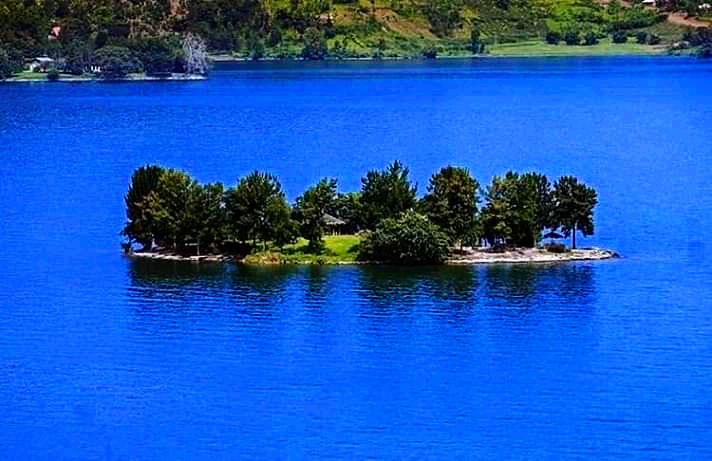
Straddling the border between Rwanda and the Democratic Republic of the Congo, Lake Kivu looks like a highlight reel of an African great lake: broad, blue, ringed with hills and towns. Beneath its surface, in the deep unmixed water, it holds enormous quantities of dissolved carbon dioxide and methane. It is, in essence, a much larger and far more populated version of Lake Nyos, and roughly two million people live around its shores.
The nightmare scenario is a limnic eruption on a scale that dwarfs the 1986 disaster, potentially releasing a gas cloud over one of the most densely settled lakeshores in the region. The reassuring counterweight is that engineers are actively extracting the methane to generate electricity, which both powers Rwanda and, conveniently, defuses the lake a little every day. It is one of the rare situations where "we are slowly draining the doomsday gas to run the national grid" is genuinely the good news.
Kawah Ijen, Indonesia
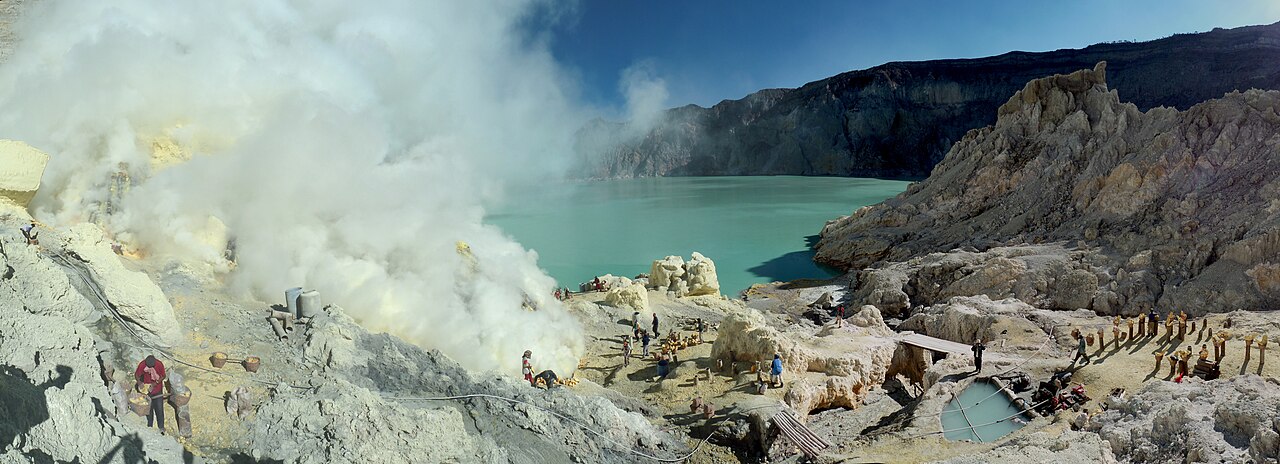
Inside a volcanic crater in East Java glows Kawah Ijen, a lake of a surreal, luminous turquoise that photographs like a jewel and behaves like a battery acid spill. It is widely considered the largest highly acidic lake in the world, with a pH that can dip near zero thanks to the sulfuric and hydrochloric acid dissolved into it. The gorgeous colour is a direct advertisement of exactly how much you should not touch it.
At night the crater performs its party trick: escaping sulphurous gases ignite on contact with the air and burn an electric blue, the famous "blue fire" that draws photographers up the mountain in the dark. Doing this business daily are the sulphur miners, who hack chunks of solid yellow sulphur from the crater's vents and carry crushing loads out on their shoulders, through fumes that would floor most visitors, for wages that make the whole scene feel deeply unfair. It is one of the most extraordinary places on this list, and one you experience through a gas mask.
If all of this has soured you on lakes as a concept, that is an understandable overcorrection, and the fix is easy. The overwhelming majority of the world's lakes are perfectly happy to have you, and a few are so pleasant they've become entire holidays: consider the mirror-calm, aperitivo-flanked shores of our Lake Como guide, or the high, thin-aired blue of Lake Titicaca, which sits at altitude but has never once tried to gas a village. For more places that seem to break the rules of nature without technically breaking the rules of physics, see our roundup of natural wonders that sound fake.
Disclaimer: none of the lakes above should be swum in, sipped from, waded into, or dared. Admire from the shore, keep your gas mask handy, and remember that "it's just a lake" is a sentence that has, historically, not always aged well.