
Bolivia Highlights
Bolivia's classic altiplano run - La Paz in its canyon bowl, the Bolivian side of Lake Titicaca and Isla del Sol, the Salar de Uyuni and the southwest lagoon country, the silver mountain at Potosí, then a welcome descent into whitewashed Sucre.
9–17 days · Point-to-point
When to go
- WeatherSalar de Uyuni: mirror season vs 4x4 access (Dec - Mar (wet) vs May - Oct (dry)) — This is the real trade-off of the route, and you cannot have both. In the wet season a thin sheet of water turns the salar into the mirror you've seen in photographs - but it also closes off large parts of the flats to vehicles, and the multi-day southwest lagoon circuit is the first thing tours drop. In the dry season you get the hexagonal salt polygons, reliable access to Incahuasi and the full southwest loop, but no reflection. This route's best_months assume dry season because the rest of the country (Amazon, mountain roads, altiplano buses) is also at its best then; if the mirror is your reason for going, travel in Feb - Mar and accept a reduced salar tour.
- NoteAltitude - the through-line of this route — La Paz sits around 3,600m (El Alto airport is higher still, near 4,050m - you land high, before you've acclimatised at all), Lake Titicaca around 3,800m, the salar around 3,700m, and Potosí is one of the highest cities in the world at roughly 4,000m. Sucre, at about 2,750m, is the only real relief and is deliberately placed last. Build in the first two La Paz nights as acclimatisation, not sightseeing: go slow, drink water, skip alcohol the first night. Anyone prone to altitude sickness should add buffer days and talk to a doctor about acetazolamide before leaving home.
- FestivalCarnaval de Oruro (Feb (movable - tied to Lent)) — A UNESCO-recognised carnival and one of the great folk spectacles of the Andes, a few hours from La Paz. It lands squarely in the wet season, so it pairs naturally with a mirror-season Uyuni trip and badly with this route's dry-season default. Accommodation in Oruro is booked out far ahead.
- VisaBolivian entry requirements vary sharply by nationality — check your own passport's requirement well before booking
Bolivia is the country travelers skip because Peru is next door and easier - which is exactly why it's worth eleven days on its own. The Peru trail bolts Bolivia on as a rushed Uyuni detour; do that and you get the photograph without the country. Given its own trip, Bolivia is the most physically dramatic thing in South America: a capital poured into a canyon and served by cable cars, the Inca's birthplace-of-the-sun on an island with no roads, the largest salt flat on earth with a desert of coloured lagoons behind it, the mountain that funded an empire and ate its workers, and - at the very end, deliberately - a warm white colonial city where you can finally breathe. The organising constraint isn't distance, it's altitude: nearly everything here is above 3,600m, so the route is sequenced to let your body catch up, and the two nights that look like slack in La Paz are the ones holding the trip together.
This route's vibe
What you get across the whole trip, blended from each stop's strengths.
Stop by stop
The route
Adjust trip length, budget, and travel style — the stops, transport, and cost update to match.
- 1
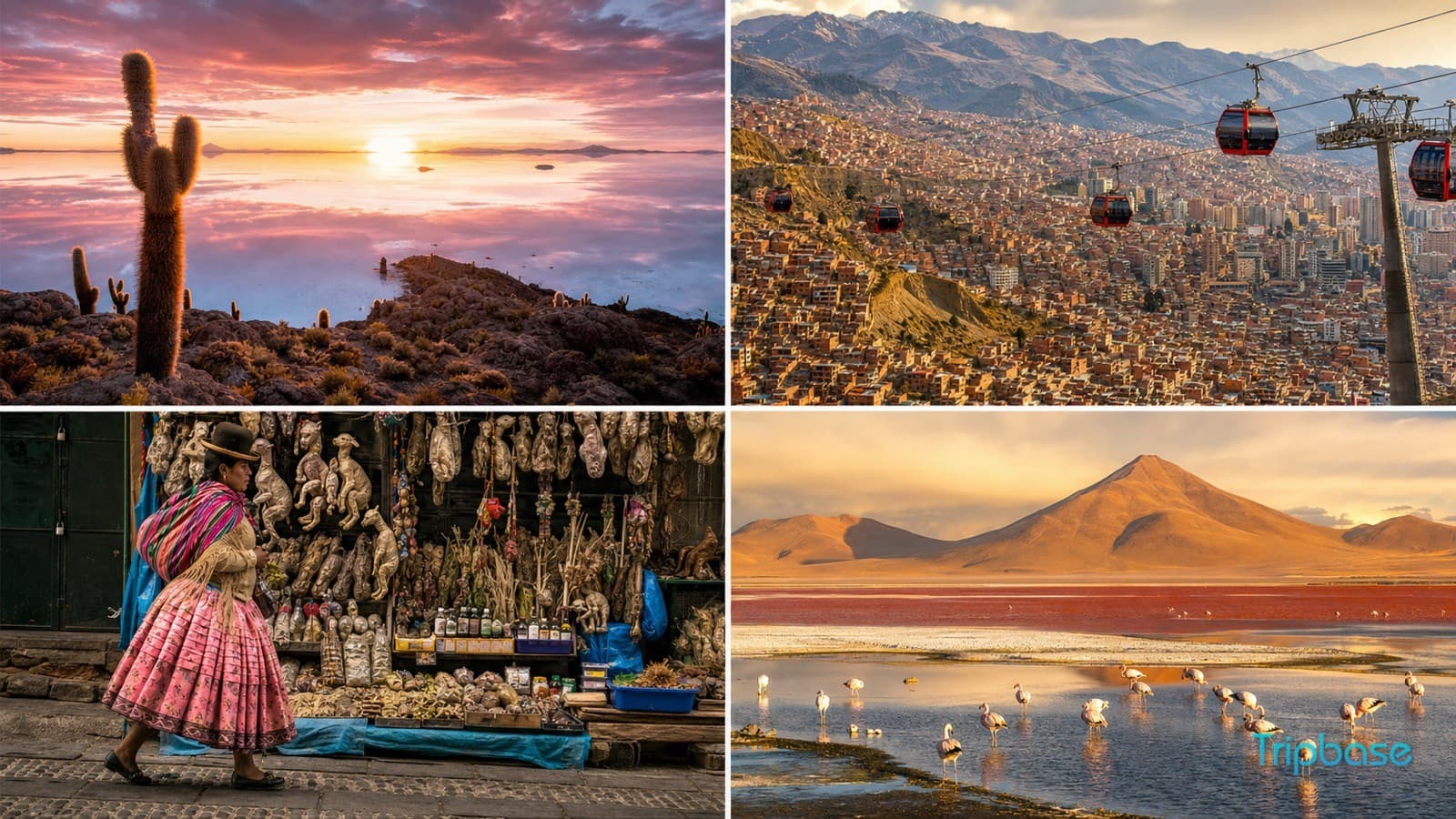
La Paz
2 nightsThe arrival hub and the acclimatisation stop - treat these two nights as medical, not optional. La Paz is built into a canyon, so the city's own geography does the sightseeing for you: ride the Mi Teleférico cable-car network (genuine public transport that happens to be the best city view in South America) between the bowl and El Alto on the rim. The Witches' Market, the Valle de la Luna badlands and a day of doing very little all fit here.
Skip / overrated: Don't book the Death Road ride for your first full day - it starts near 4,650m and drops thousands of metres, and doing it before you've acclimatised is how people end the trip early. If you want it, put it after Titicaca.
View La Paz guide→Getting there· ~106 kmBusRecommendedTourist minibuses run the La Paz - Copacabana road as a straightforward half-day. The quirk of this leg is the Estrecho de Tiquina: the bus is barged across the strait while passengers cross in a separate small boat and rejoin it on the far side. It's normal, it's brief, and it surprises everyone the first time - keep your valuables on you rather than on the bus.
Book: Rome2Rio / tour-operator offices on Calle Sagárnaga — the cheap 'direct' services are often a sold-on seat that leaves you waiting at a transfer point - pay slightly more for a named operator
Book busesCarA private car or taxi does the same route with the same barge crossing, and lets you stop at the lake viewpoints on the descent into Copacabana. Worth it for a group splitting the cost.
Book: hotel desk / local operator
- 2
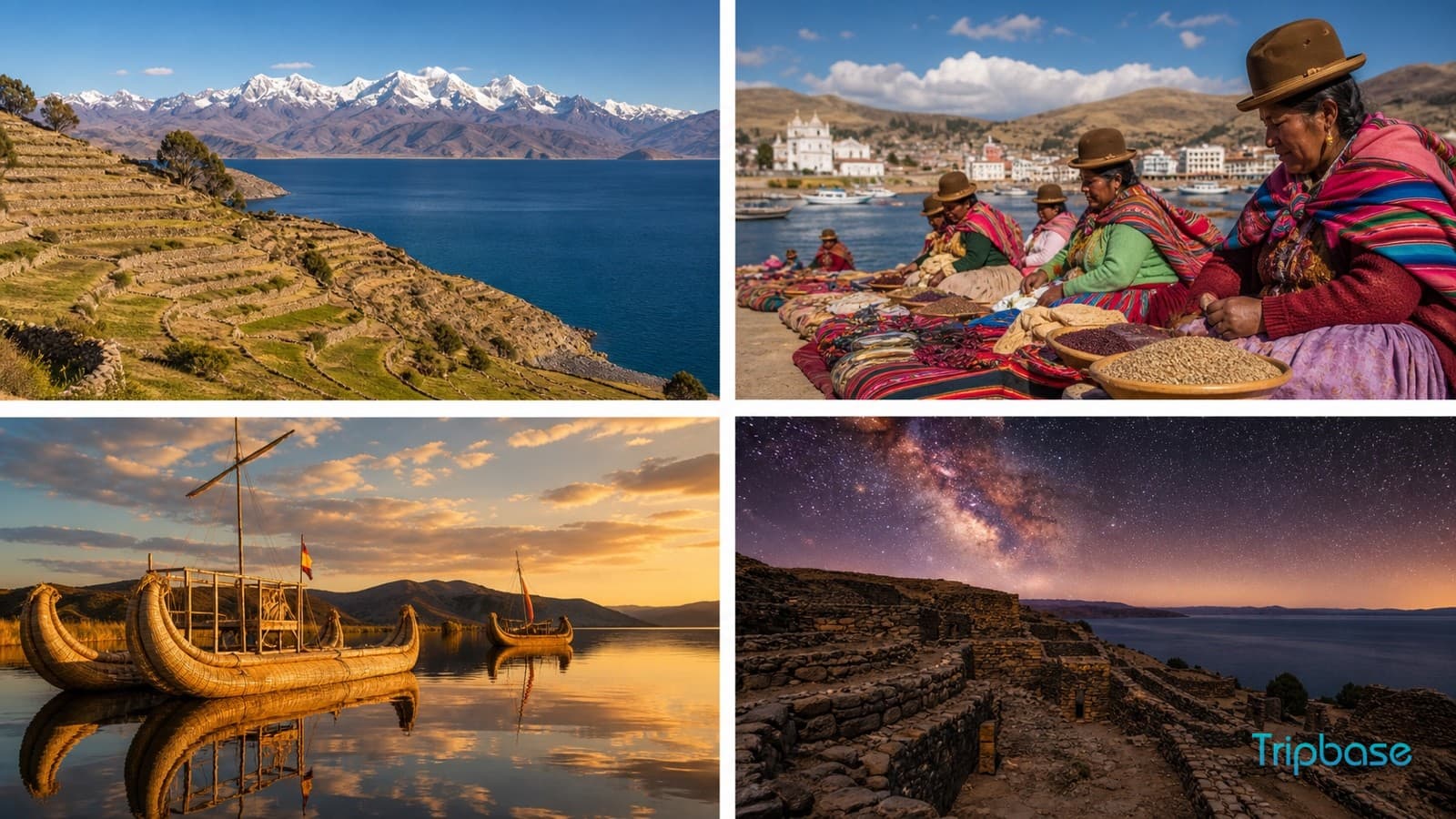
Lake Titicaca (Copacabana & Isla del Sol)
2 nightsThe Bolivian shore of the lake, and a quieter, more devotional proposition than the Peruvian side: Copacabana's basilica draws pilgrims who come to have their vehicles blessed, and Isla del Sol - the island the Inca called the birthplace of the sun - is walkable, roadless and worth an overnight rather than a day boat. Sleeping on the island, at altitude, with no traffic, is the memory people keep.
Skip / overrated: Copacabana town itself is a base, not a destination - one night there and one on Isla del Sol beats two in town.
View Lake Titicaca (Copacabana & Isla del Sol) guide→Getting there· ~472 kmFlightRecommendedFlying La Paz - Uyuni turns the whole backtrack into a short hop and buys back the better part of a day - the single highest-value time purchase on this route. Schedules are thin and cancellations are not rare, so don't connect it tightly to a tour departure.
Book: airline direct / meta-search — book the salar tour to start the day AFTER you land, not the same afternoon
BusThere is no useful direct link - in practice you backtrack to La Paz and continue south from there, which is why this leg eats a travel day. The La Paz - Uyuni overnight bus is the budget standard and the quality range is enormous; the altiplano gets brutally cold after dark, so a heated 'cama' service is worth the upgrade, and bring your own blanket regardless.
Book: Rome2Rio / Villa Fátima and Terminal de Buses ticket counters in person — 'heating' is claimed far more often than it is fitted - this is the one leg where paying up for a reputable operator genuinely changes the night
Book buses - 3
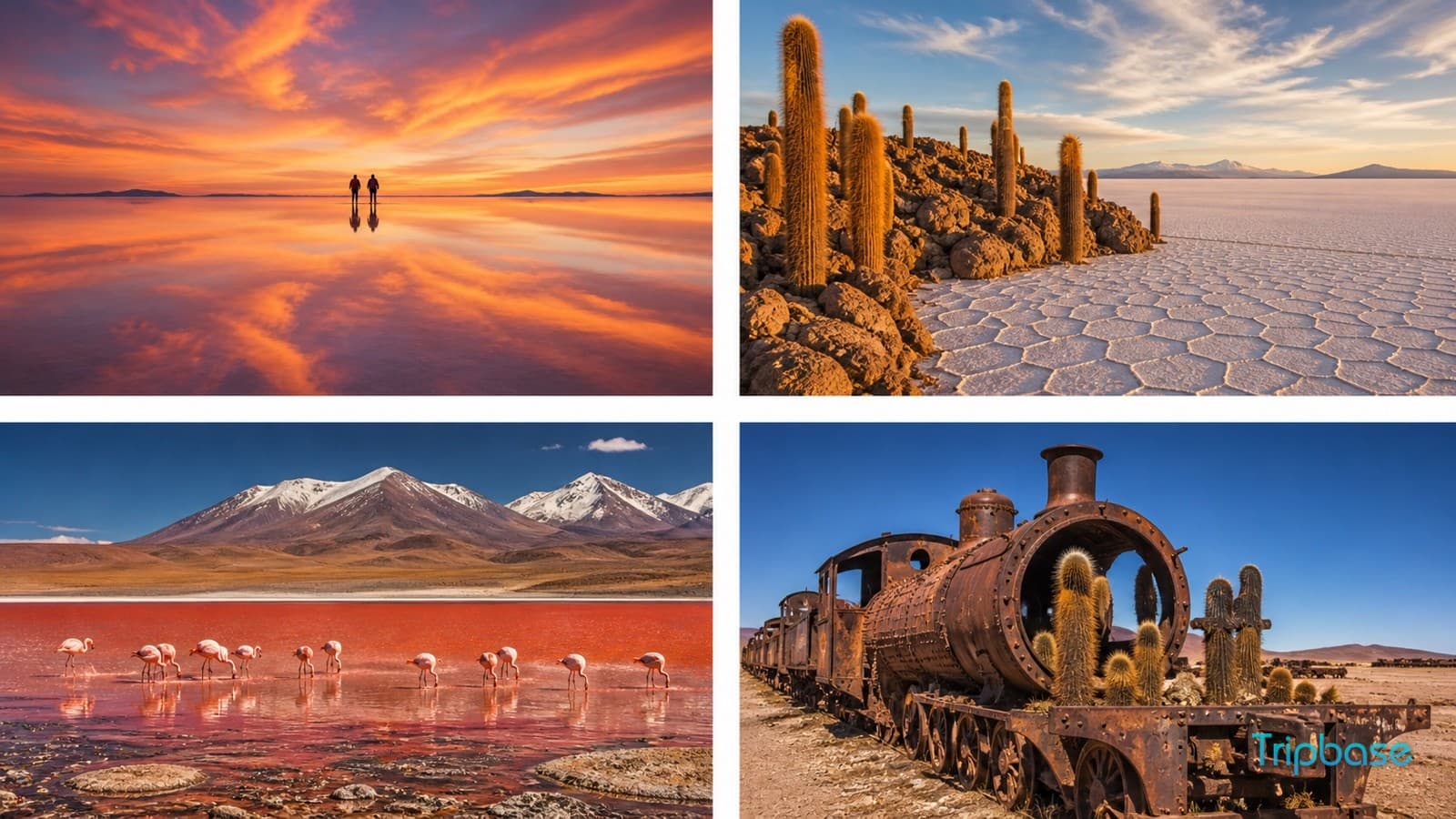
Salar de Uyuni
3 nightsThe reason most people come to Bolivia, and three nights is the honest number - the salar itself is a day, but the standard southwest circuit continues past it into the Eduardo Avaroa reserve: coloured lagoons, flamingos, geysers and the Siloli desert, sleeping in basic refuges at serious altitude. Incahuasi, the cactus-covered island in the middle of the flats, is the classic dry-season stop.
Skip / overrated: Uyuni the town is a dusty transit point with nothing to detain you; it exists to launch tours. Do not pick your operator on price alone - the southwest circuit is long-distance driving on remote tracks, and the cheapest operators have a documented history of exhausted or drinking drivers. Ask directly about driver rotation and read recent reviews, not the wall of laminated photos.
View Salar de Uyuni guide→Getting there· ~192 kmBusRecommendedA paved, scenic half-day climb across the altiplano - one of the more comfortable Bolivian bus legs, and a daytime run, so you actually see it. Note you finish it higher than you started.
Book: Rome2Rio / Uyuni bus terminal in person
Book busesCarPrivate transfer on the same road; buys flexibility rather than time.
Book: hotel desk / local operator
- 4
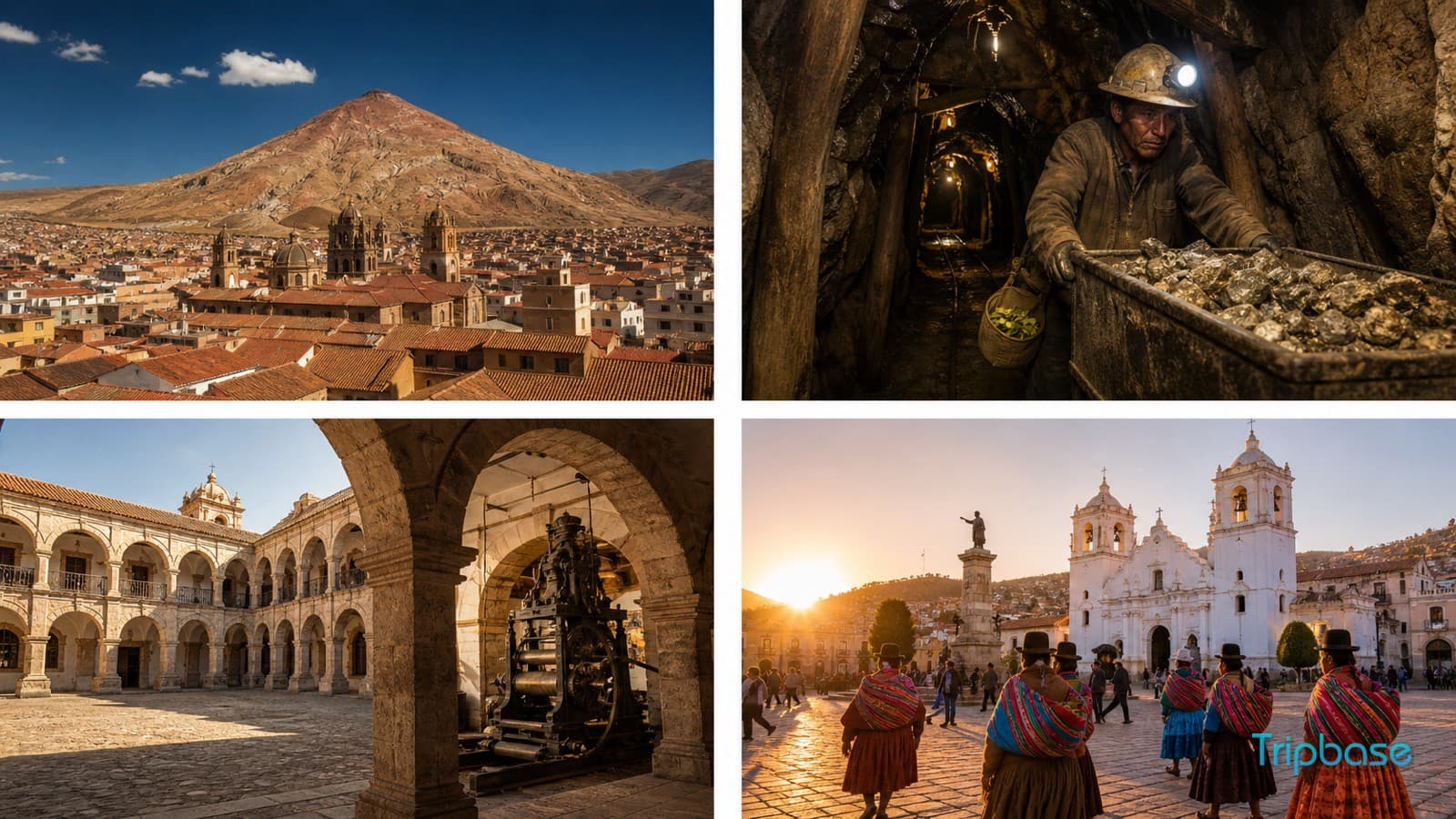
Potosí
1 nightOnce one of the richest cities on earth and now among the highest, Potosí is a single, heavy night: Cerro Rico, the silver mountain that bankrolled the Spanish empire and consumed an appalling number of Indigenous and enslaved African lives, still looms over a colonial centre of churches and the Casa Nacional de la Moneda mint. It is the most historically serious stop on the route.
Skip / overrated: Be clear-eyed about the working-mine tours: Cerro Rico is a still-active cooperative mine with unstable shafts, silica dust and dynamite, and the miners' life expectancy is short. Some travelers find the visit a genuine, miner-guided education; others find it tourism inside someone's dangerous workplace. If you go, go with a cooperative-run outfit that employs ex-miners. If that sits wrong, the Casa de la Moneda tells the same story without the ethical bill - and Potosí at 4,000m is a rough place to spend a day underground anyway.
View Potosí guide→Getting there· ~81 kmBusRecommendedThe shortest and easiest leg of the route: frequent buses and shared taxis run the Potosí - Sucre road all day, and it's a steady descent of well over 1,000m. Most people notice they can breathe again before they reach Sucre.
Book: Rome2Rio / bus terminal in person — no need to pre-book - turn up and take the next departure
Book busesCarShared or private taxis are cheap on this leg and faster than the bus; the standard choice if there are two or more of you.
Book: bus terminal taxi rank / hotel desk
- 5
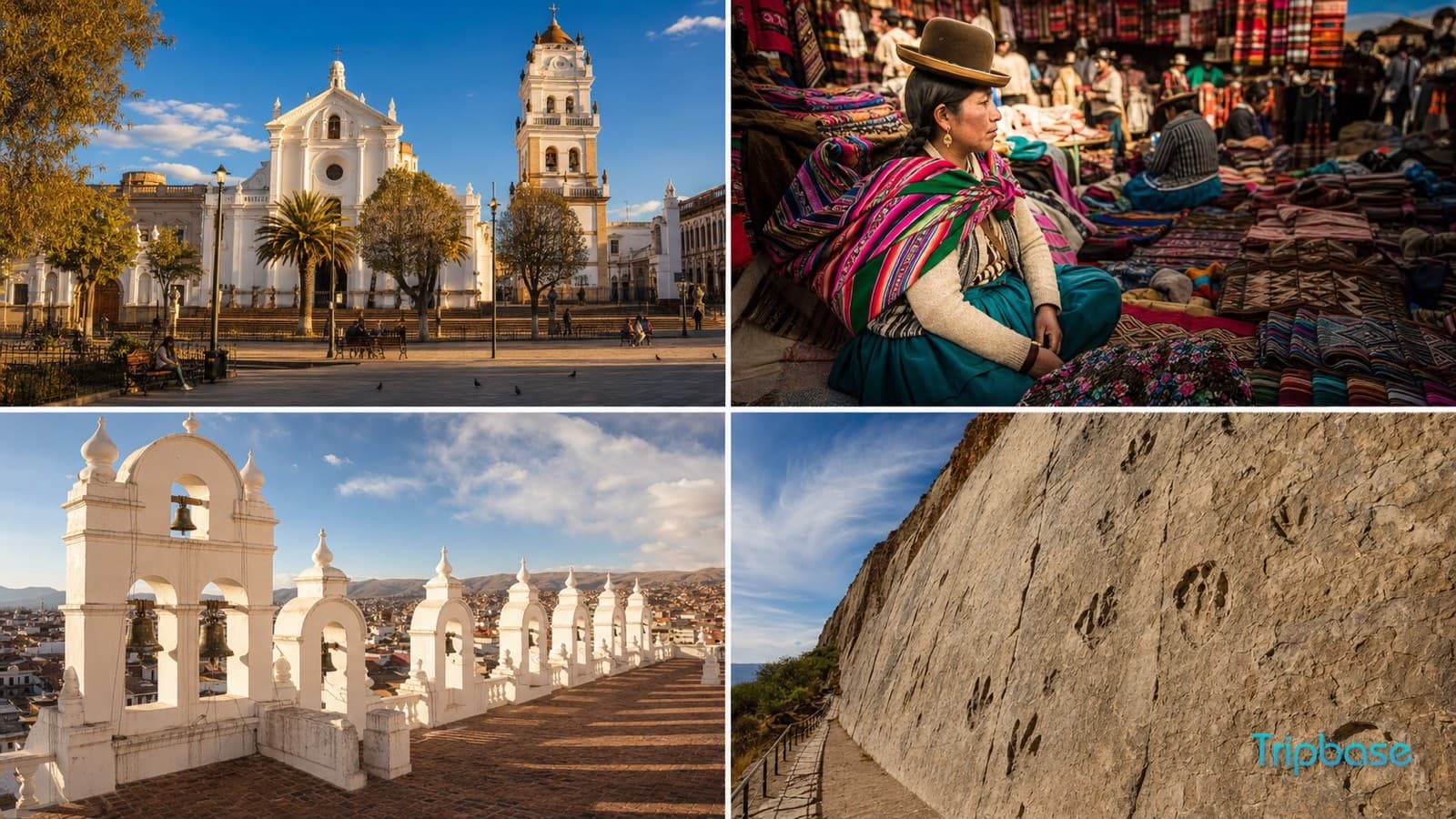
Sucre
2 nightsThe constitutional capital and the exhale at the end of the route - whitewashed, UNESCO-listed, full of students, and at roughly 2,750m the first place your body stops negotiating. Good food, warm afternoons, a dinosaur trackway at Cal Orck'o, and the best-value Spanish schools in South America, which is why travelers who intended three nights here stay three weeks. It's also the cleanest place to end the trip, with flights back to La Paz.
Eat: Sucre is where the food gets good after the altiplano: the central market's fruit-juice counters and salteña stalls at mid-morning are the local ritual, not a tourist one.
View Sucre guide→
Lodging + daily spend only — excludes flights & intercity transport.
What to skip
Don't try to bolt this onto the end of a Peru trip with three spare days - the Peru route's own advice is right about that, and a rushed Uyuni run out of Cusco means arriving at 3,700m already tired, seeing the flats in a day, and leaving. Skip Uyuni town as anything but a launchpad, skip the Death Road until you're acclimatised, and skip the temptation to shorten the southwest circuit to a one-day salar trip - the lagoons behind the flats are the half of it that people don't expect and end up preferring.
Practical tips
Carry cash: ATMs are unreliable outside La Paz, Sucre and Santa Cruz, and the salar circuit is cash-only for park fees and refuges. Bolivian buses are cold and their advertised heating is aspirational - pack a real layer for the overnight. Coca tea and coca leaves are legal and ubiquitous here, and they help mildly with altitude, but they are not a substitute for going slow and they will not clear a drug test at home. Book nothing tightly around Uyuni flights.
Best for
Common questions
When should I go to Uyuni - wet season for the mirror, or dry season?
It depends which photograph you're chasing, and you can't have both. Dec - Mar puts a sheet of water on the salar and gives you the mirror, but restricts vehicle access and often cuts the multi-day southwest lagoon circuit. May - Oct gives you the salt polygons, reliable access to Incahuasi island and the full lagoon loop, plus better conditions everywhere else in the country. This route defaults to dry season because it's a whole-Bolivia itinerary, not just a salar trip - but if the mirror is your reason for coming, go in Feb - Mar and accept a shorter tour.
How bad is the altitude, really?
It's the defining feature of the trip. You land at El Alto near 4,050m before you've adjusted to anything, and La Paz, Titicaca, Uyuni and Potosí all sit above 3,600m - Potosí is roughly 4,000m. Most people feel headachy and breathless for a day or two and then adapt. The mitigation is boring and it works: two genuine do-nothing nights in La Paz to start, plenty of water, no alcohol the first night, and no strenuous plans (Death Road, hikes) until you've settled. Sucre at ~2,750m is placed last on purpose. If you're prone to it, add buffer days and ask your doctor about acetazolamide before you fly.
Is eleven days enough, or should I add the Amazon?
Eleven covers the altiplano circuit properly. If you have seventeen, flying to Rurrenabaque for Madidi and the pampas is the strongest addition - partly because it's a completely different Bolivia, and partly because dropping to 200m for three nights resets the altitude fatigue better than any rest day up high. Nine days works if you cut Potosí; don't cut the Uyuni circuit to make room.